
SIAP and Japanese Partners Discuss Future Directions for Statistical Capacity Development
High-level meetings underscore Japan's longstanding partnership with SIAP and a shared commitment to stronger statistical capacity and lasting institutional impact across Asia and the Pacific.
Tokyo, 23 October 2026 – Building on nearly six decades of partnership, the United Nations Statistical Institute for Asia and the Pacific (SIAP) and senior Japanese government officials explored ways to strengthen statistical training, deepen technical cooperation and respond to evolving regional needs.
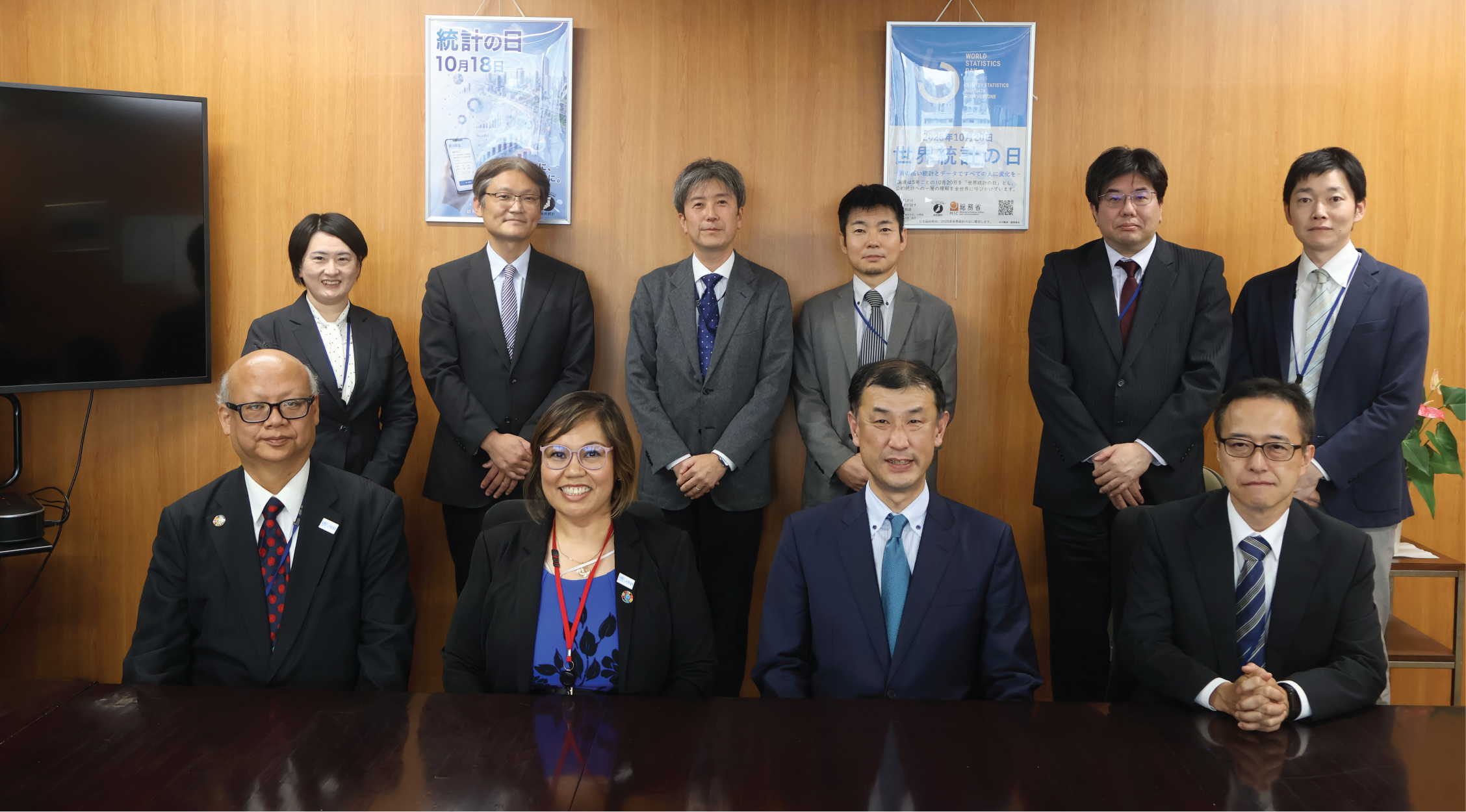
SIAP Director Jessamyn Encarnacion, accompanied by Deputy Director Seiji Takata, met with Katsuhiko Sakamoto, Vice-Minister for Policy Coordination, Ministry of Internal Affairs and Communications (MIC); Koji Shichijo, Director-General for Policy Planning on Statistical Policy, MIC; Yusuke Katou, Director for International Statistical Affairs, MIC; Tetsuya Natsume, Director for International Training Cooperation, MIC; Katsutoshi Nagashima, Director-General of the Statistics Bureau of Japan; and Shuji Saiki, President of the National Statistics Center.
Building on Japan's longstanding commitment
Since 1970, Japan has been SIAP's host country and principal financial and institutional partner. Its sustained support—from training facilities to technical expertise—has helped develop generations of statistical professionals, including chief statisticians and senior leaders of national statistical systems, strengthening statistical capacity and institutions across Asia and the Pacific.
Welcoming Director Encarnacion, Vice-Minister Sakamoto recognized the growing responsibilities of national statistical offices and SIAP's increasingly important role. Noting continued demand for long-term, in-person training, he affirmed:
"We look forward to working closely with SIAP to respond to these needs and to meet the evolving expectations of countries across the region."
Director-General Shichijo echoed this commitment to meeting regional needs:
"We hope to continue working together to respond flexibly to the needs and requests of SIAP member countries and areas."
He also emphasized that MIC's engagement extends beyond operational support to joint discussions on training strategies and capacity development.
Together, the discussions highlighted opportunities to expand face-to-face training in Japan, make greater use of SIAP's facilities and plan for longer-term needs—while keeping programmes responsive and sustainable.
Director Katou facilitated and moderated all four meetings, helping guide constructive discussions on SIAP's future direction and stronger cooperation with Japanese institutions.
“I was impressed by Director Encarnacion's enthusiasm and energy, which made our meetings a truly substantive exchange of views rather than simply a formality. I look forward to further strengthening our cooperation.”
Director Natsume has maintained close, regular and constructive engagement with the Institute on programme priorities, capacity development needs and future directions—reflecting the strong working relationship between SIAP and MIC.
“We believe there is considerable potential to further expand SIAP's training programmes and strengthen its institutional capacity to meet the growing needs of countries across the region. We look forward to working closely with SIAP to translate these opportunities into concrete and sustainable initiatives.”
SIAP shared its 2027 plans to increase face-to-face training and broaden partnerships. The exchanges also looked ahead to 2027–2029, linking country needs and training priorities with the resources required for lasting results.
Deepening technical cooperation
Meetings with the Statistics Bureau of Japan and the National Statistics Center highlighted Japanese experts' contributions and opportunities to deepen technical cooperation.
With Director-General Nagashima, discussions focused on statistical methodology, professional training and statistical literacy, building on joint initiatives and the contributions of Statistics Bureau experts as lecturers.
With President Saiki, discussions explored practical learning in statistical production, data processing, dissemination and emerging technologies, drawing on the Center's experience in modernizing statistical operations.
Together, these partnerships help statistical professionals bring practical skills and approaches back to their institutions.
Strengthening results and institutional impact
Across the meetings, a central theme was how SIAP can better demonstrate the longer-term results of its training—not only individual learning, but improvements within national statistical systems.
Drawing on her experience as a government statistician, former SIAP training participant and visiting lecturer, Director Encarnacion stressed the importance of what happens after participants return to their workplaces:
“SIAP's success is not simply how many courses we deliver or people we train. It is what changes as a result: better statistical practices, stronger institutions and statistics that inform better decisions. By continuing to assess and learn from these results, we can strengthen the relevance, effectiveness and impact of our work.”
SIAP will build on existing evidence and strengthen follow-up to assess how learning is applied, how statistical practices improve and what these changes mean for institutional performance. The findings will shape future programmes.
The exchanges reinforced Japan's vital role in SIAP's future, including efforts to strengthen the Institute's institutional capacity and long-term sustainability as it pursues its priorities under its 2025-2029 Strategic Plan.
As SIAP approaches its 60th anniversary in 2030, the partnership offers an opportunity to demonstrate enduring results: more capable statistical institutions and stronger national statistical systems across Asia and the Pacific.